What is Truth? And What is 'Walking-Dead' Syndrome?
Dave Deriso · 2011
Originally published on February 14, 2011 in The Artful Brain under Nature Publishing Group (see original version)
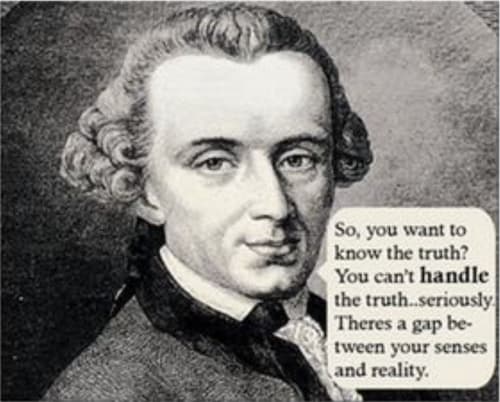
If you were asked to define the word ‘truth,’ what would you say? As we saw in the last discussion where the artist took LSD, our concept of reality is actually quite malleable. If reality is subjective, then truth may be as well —after all, how can you tell the artist that the wall isn't melting, when the wall is clearly melting?
The 18th-century German philosopher, Immanuel Kant (1704–1804), argued that we simply can't know truth. In 1785, he published his arguments in an essay entitled Grundlegung zur Metaphysik der Sitten (Groundwork of the Metaphysics of Morals). If one cannot know anything without experience through the senses, he reasoned, then we can only know things as they are to us —we can never know reality as it actually is. Kant obviously didn't stop the scientific pursuit of truth, but he did caution that appearances can be deceiving.
Truth, as it is often encountered in science, is a concept whose proof has resisted attack for so long, it has earned tenure in that school of thought. But this system doesn't work in every case —there are some ideas where the definition of truth is challenged.
In the spring of 1880, the French neurologist Jules Cotard (1840–1889) delivered a lecture to the Société Medico-Psychologique where he reported the case of a 43-year-old woman, whom he referred to as “Mademoiselle X,” who believed that she had “no brain, nerves, chest, or entrails, and was just skin and bone”, that “neither God or the devil existed”, and that she did not need food for “she was eternal and would live for ever.” She had asked to be burned alive and had made various attempts at suicide. Mademoiselle X, Dr. Cotard claimed, was suffering from a rare neurological condition he called le délire de negation (negation delirium).
Le délire de négation, or Cotard's syndrome (also known as ‘walking-dead syndrome’), was a term used to classify “those cases in which patients show a marked tendency to denying everything.” One could only wonder what Immanuel Kant would have learned from them. The belief of being dead is as true to them as being alive is to us. In fact, some even offer a proof — they even claim to smell their own flesh rotting! What do you say to a patient who claims that he is dead?
Fast forward a century, and even though doctors can peer into the brain with tools like MRI, the cause of Cotard's curious syndrome still remains unclear. Some neurologists, such as VS Ramachandran, have suggested that it is caused by a severe lesion in the limbic system pathways that disconnects the patient from feeling any emotion to visual stimuli. In the case of Cotard's syndrome, this emotional numbness is so pervasive, they feel utterly disconnected with the world around them to the extent where they feel as though they have died.
This perspective, although not formally accepted, is supported by the similarity of Cotard's syndrome symptoms to the Capgras illusion, where the patient no longer feels emotional connection to faces that would have otherwise evoked great emotion, such as one's parents. The Capgras illusion, which results from a limbic lesion that disconnects the facial recognition area known as the fusiform gyrus from limbic areas such as the amygdala, was also reported (but not discovered) by Cotard. In 1884, he reported the case of a man suffering from melancholia and nihilistic delusions who complained of an inability even to “visualize the features of his own children.” Cotard went on to suggest that nihilistic delusions might be secondary to a “loss of mental vision.” This striking similarity of cause and symptom puts Cotard's syndrome on the map of lesion disorders, and shows that even for his time, Cotard was a very modern thinker.
So what does all of this teach us about truth? If we assume that truth is a constant and a belief is a variable, then it may be such that some truths are beyond the faculties of our minds to believe in. And even Kant doesn't have an answer for that.
How do we understand, comprehend, or attempt to reason with that which is beyond us? The answer is the topic of our next discussion.
References
- Ramachandran, VS. & Blakeslee, S. (1999). Phantoms in the Brain: Probing the Mysteries of the Human Mind
- Berrios, G.E. & Luque, R. (1999) Cotard's ‘On hypochondriacal delusions in a severe form of anxious melancholia’. History of Psychiatry 10: 269–278.
- Wolff, Robert Paul. The Autonomy of Reason: A Commentary on Kant's Groundwork of the Metaphysic of Morals. New York: HarperCollins, 1974.